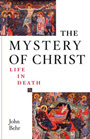
A book by one of the most significant Orthodox theologians writing today- so say people smarter than me- and which seeks to explain "the reappropriation of a premodern perspective in a cautious postmodern fashion," ought to be of interest to Oozerdoxies and those who love (?) us.
Fr. John is professor of patristics at St. Vladimir Orthodox Seminary. His ongoing project is a series on the formation of Christian theology, one volume already laying out
"The Way to Nicea" and the other the
formation of Nicene faith. This small book can be seen as a companion volume to those, while standing as a compelling work in its own right.
The "mystery of Christ" is that Christ is at the center of absolutely everything. He is the axis around which all of the universe turns, all of our understanding of who God is, who we are as the church, and of what truth is. Fr. John asks us to go back in time before the formulations and systematizations of later centuries, which tend to put the gospel in the form of an historical narrative beginning at the beginning and leading forward. In this journey back in time we are not seeking a pristine, primitive church age, but Christ Himself.
He writes: "When the apostle Paul speaks of 'its breadth and length and height and depth' (Eph. 3:18), St. Gregory [of Nyssa] sees him as inscribing the figure of the cross into the very structure of the universe created by 'the God revealed through the Cross'... It is likewise only in this way, 'through the church', that the heavenly powers come to know 'the manifold wisdom of God' (Eph. 3:10)." The cross of Jesus Christ is the centerpoint of the universe, mirroring and being mirrored by all creation, and most significantly, an absolutely unique revelation of God.
The first implication of this cruci-centric view of all things is that Christ is at the center of the Scriptures. We have been so influenced by modern historical-critical method, Fr. John argues, that we have a difficult time reading them any other way. Yet for the early fathers, "the Word of God" referred not to a book but to a Person. There is no meaning in the Scriptures except that which reveals Christ. For the early fathers, the Jewish Scriptures were less historical narrative and more a library of images, prototypes and visions testifying to Jesus Christ. Similarly, the New Testament canon can be understood as having been gathered around the theological center of Christ's Passion moreso than any historical or textual criterion.
He uses the illustration provided by St. Irenaeus of a mosaic, whose tiny jewels only acquire their true beauty when seen according to the design revealed on the Cross. That design is set out by the apostles' teaching, where Christ's revelation was safeguarded. Yet here again Fr. John reminds us that the focal point must be Jesus Christ. It is not enough to see the design; to unearth "the author's original meaning"; one must have personal, dynamic engagement with Christ. The Scriptures, church tradition and apostolic succession are a framework which allows this to happen. Their boundaries are not intended to limit the knowledge of God, but to allow such a genuine encounter to happen, unhindered by "regression and mythology."
(to be continued)

 A book by one of the most significant Orthodox theologians writing today- so say people smarter than me- and which seeks to explain "the reappropriation of a premodern perspective in a cautious postmodern fashion," ought to be of interest to Oozerdoxies and those who love (?) us.


